
Answer

Sum time per month and use it as an trigger or automation

  • April 7, 2021
  • 2 replies
  • 36 views

Hi!

With our team we use Airtable for a lot of useful practices and one of them is time tracking. My question is about how to trigger an automated message when a single person writes more than for example 10 hours on a customer in a certain month.
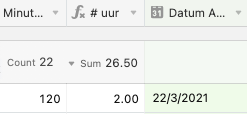
My (un)logical idea start was. To sum the time per month in a formula column. But i have no clue what kind of formula I need.

Does anybody has an idea?

Many thanks in advance!

Best answer by Justin_Barrett

Welcome to the community, @Blinkt_Uit! :grinning_face_with_big_eyes: When Airtable executes a formula in a given cell, that formula only has access to other data in the same record (row). It’s not possible to use a formula in that sense to sum numbers from the same field (column).

What you could do, however, is link each entry to a customer record, and do the calculation in the customer record using a rollup field using the SUM(values) aggregation formula.

2 replies

Justin_Barrett
Forum|alt.badge.img+21

Welcome to the community, @Blinkt_Uit! :grinning_face_with_big_eyes: When Airtable executes a formula in a given cell, that formula only has access to other data in the same record (row). It’s not possible to use a formula in that sense to sum numbers from the same field (column).

What you could do, however, is link each entry to a customer record, and do the calculation in the customer record using a rollup field using the SUM(values) aggregation formula.


  • Author
  • New Participant
  • February 9, 2022

Welcome to the community, @Blinkt_Uit! :grinning_face_with_big_eyes: When Airtable executes a formula in a given cell, that formula only has access to other data in the same record (row). It’s not possible to use a formula in that sense to sum numbers from the same field (column).

What you could do, however, is link each entry to a customer record, and do the calculation in the customer record using a rollup field using the SUM(values) aggregation formula.


Hi Justin,
A little late response from my end, but thanks! it helped working out a solution.

Greetings