I am new to junction tables and have pretty much zero scripting experience, so bear with me.
I am trying to create a breakdown of call sheets for group shoots and create individual “shifts” in a junction table. The goal is to be able to adjust start and end times for those linked in the shoots and to be able to create a more comprehensive reporting interface to track hours and OT by multiple criteria.
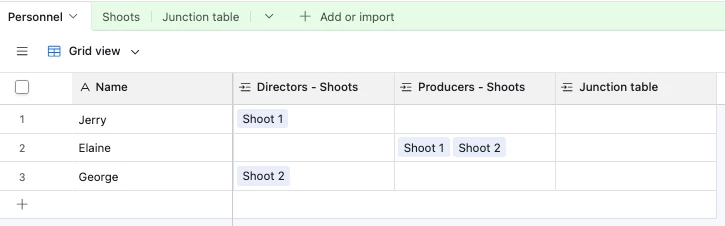
I cannot show the actual base, but have created a basic example of the structure and result of Airtable’s junction table extension.
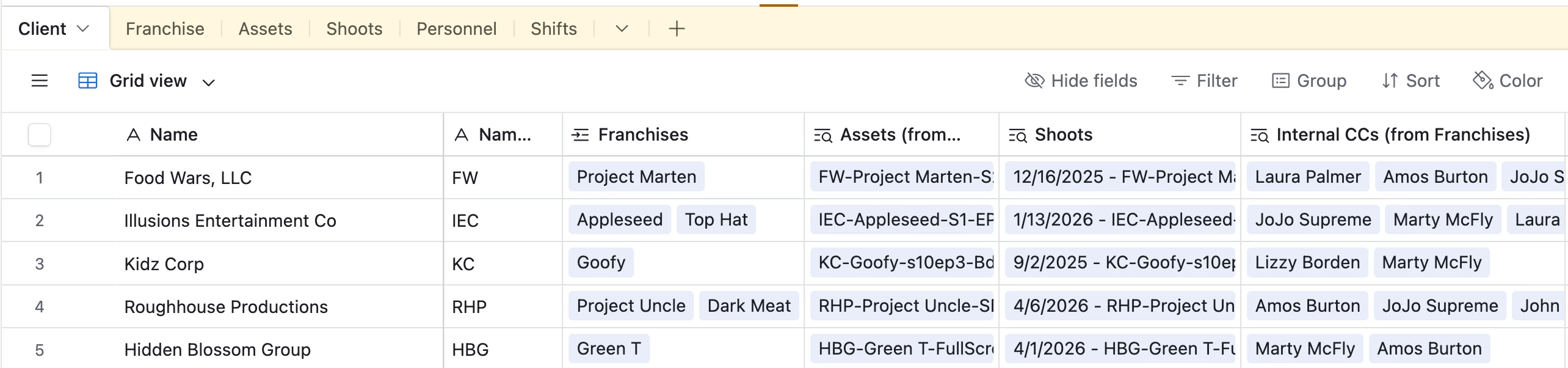
Client tab:
Franchise:
Franchises have assigned POCs for internal notifications. This could include executive roles/higher level visibility. Would not include anyone linked in “Shoots”
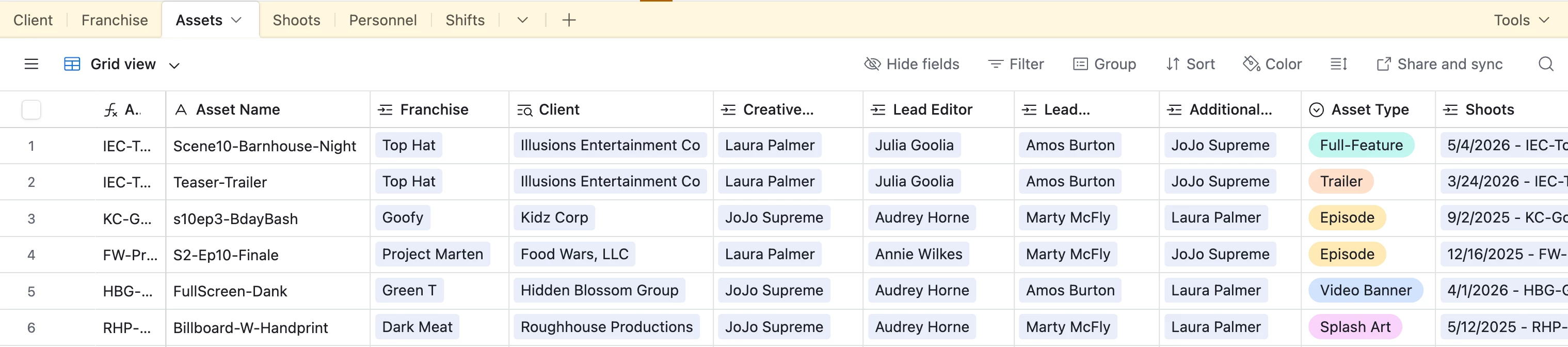
Assets:
Linked directly to Editors, Creative Directors, and Producers.
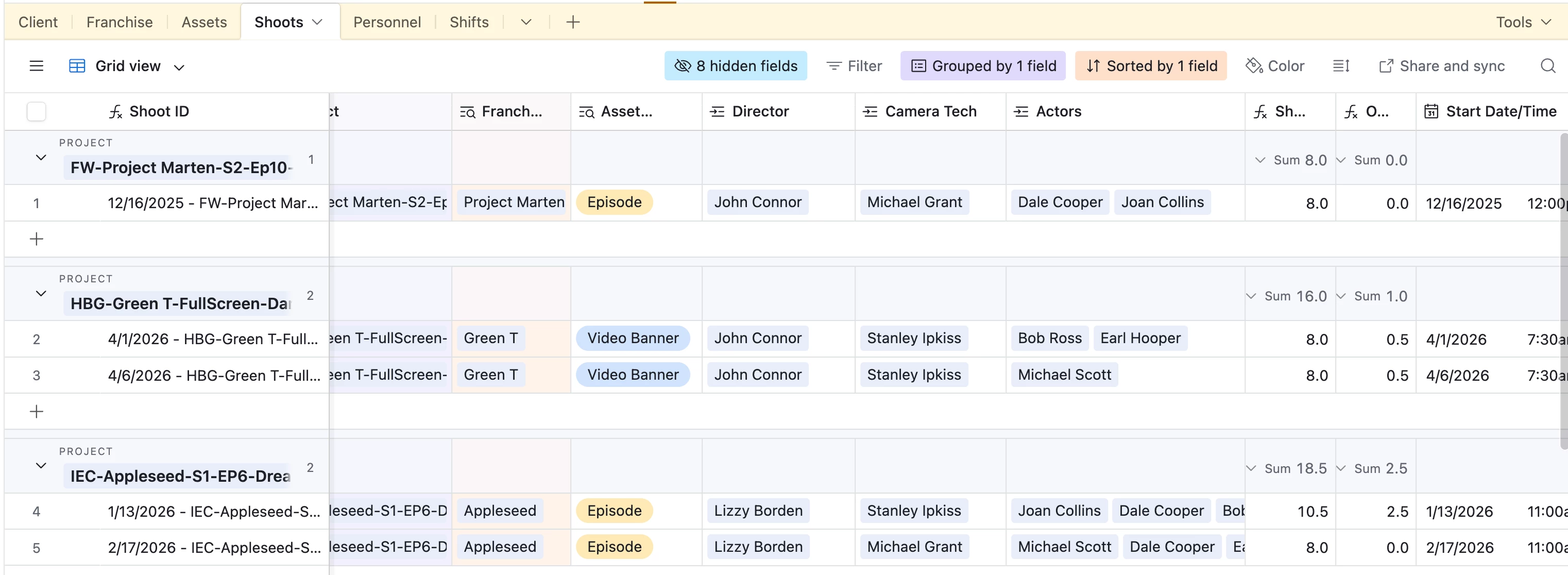
Shoots:
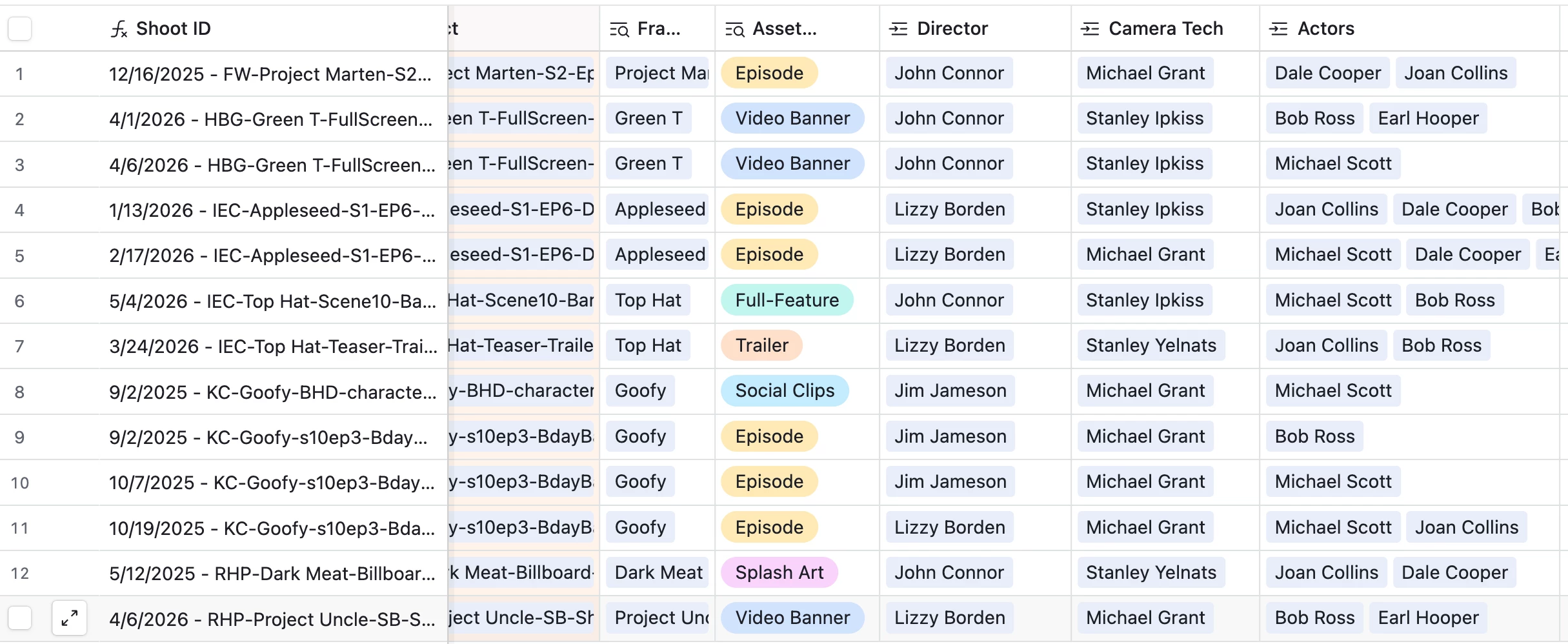
Only linked directly to Directors, Camera Techs, and Actors.
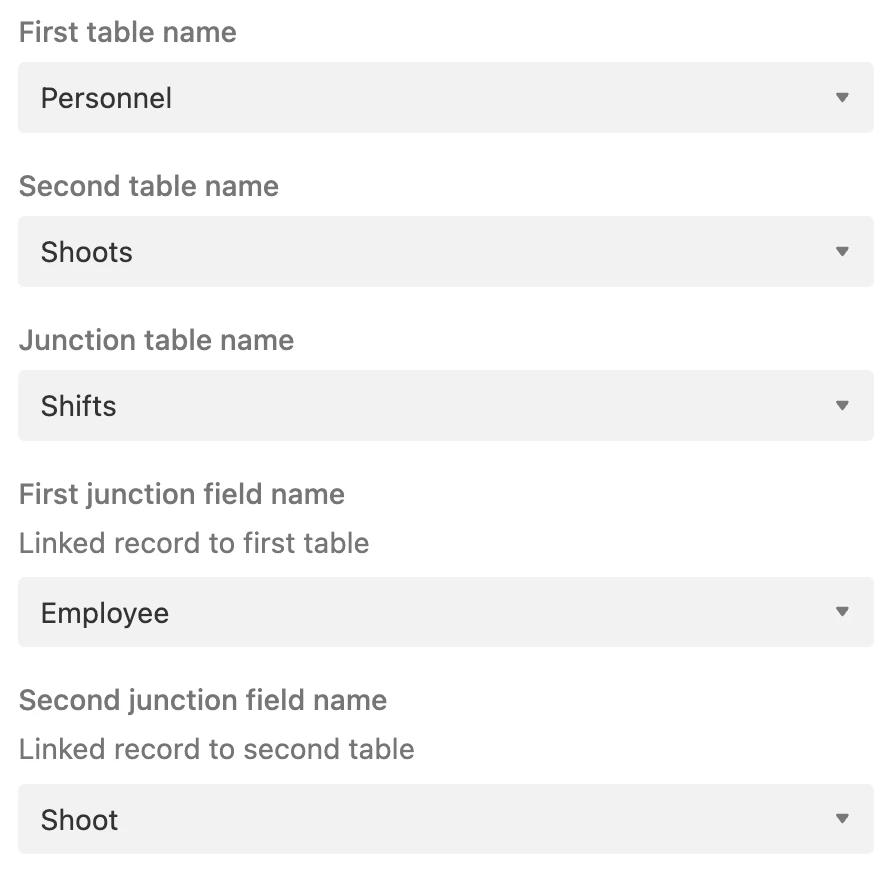
Settings for Junction Table Extension:
Result - Shifts (Junction Table)
As you can see, it is pulling in combinations for Producers, Editors, and Creative Directors when they are not directly linked within Shoots. Is there a way to restrict the junction table to parse only what is directly linked between Personnel and Shoots? I only want to consider the “shifts” of Directors, Camera Techs, and Actors.
Any help or advice is welcome, thank you!
Best answer by TheTimeSavingCo
Ah you’re right, so sorry! I’ve updated the base with a new script that I think should do what you need, let me know if it’s wrong and I’ll fix it up!
The new script will ask for:
A view in Personnel for you to select from
For each of those records in Personnel, the specific linked fields that you want to create records for
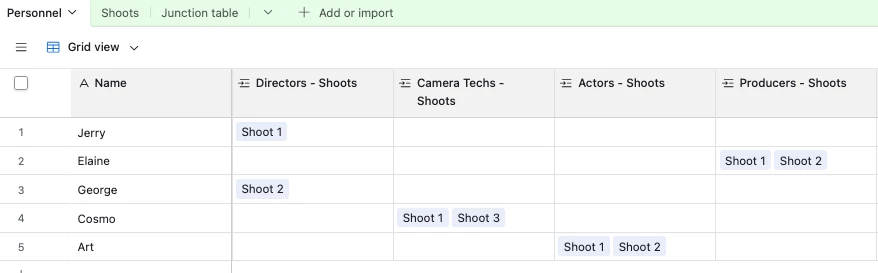
And so with reference to the screenshot below, it’ll create 2 records for Cosmo, one for Shoot 1 and one for Shoot 2
This can also be set up to be an automation, but that really depends on the workflow. Thinking about this, it feels like you’d probably be setting up all the Personnel data on a per Shoot basis, and then creating all the Shifts at once from there?
Code:
let config = input.config({ title: "Expand linked records into one record each", description: "For each record in a source view, create one record per linked record found in up to 4 optional linked fields.", items: [ input.config.table("sourceTable", { label: "Source table" }), input.config.view("sourceView", { parentTable: "sourceTable", label: "Source view" }), input.config.table("destinationTable", { label: "Destination table" }), input.config.field("destinationSourceField", { parentTable: "destinationTable", label: "Destination field linking back to the source record" }), input.config.field("destinationLinkedField", { parentTable: "destinationTable", label: "Destination field for the linked record found in the optional fields" }), input.config.field("destinationFieldNameField", { parentTable: "destinationTable", label: "Optional text field to store the source field name" }), input.config.field("optionalLinkedField1", { parentTable: "sourceTable", label: "Optional linked field 1" }), input.config.field("optionalLinkedField2", { parentTable: "sourceTable", label: "Optional linked field 2" }), input.config.field("optionalLinkedField3", { parentTable: "sourceTable", label: "Optional linked field 3" }) ] });
You are running into a classic Airtable junction table spaghetti!!!
Right now your setup looks like, Personnel <-> Shoots <-> Shifts (junction table)
But, Your Shoots table already links to multiple Personnel indirectly (Directors, Camera Techs, Actors, ... etc.) and Personnel table also has broader relationships (Producers, Editors, Creative Directors via Assets/Franchise)
I think you need to change your links... 1st, only link Personnel to Shoots directly (for people who actually work that shoot)
In your Shoots table, you should have fields like, Director (linked to Personnel), Camera Techs (linked to Personnel) and Actors (linked to Personnel)
In Shoots table, add a linked field (to Pesonnel) and call it "Assigned Personnel" (or something similar to this). This becomes your single source of truth for who is actually on a shoot.
Now, build the junction table, using only this field. So it will look like, Personnel <-> Shoots (Assigned Personnel only) <-> Shifts
Ah this is happening because the Junction Table Extension grabs every record from the Personnel table when creating the junction records, while you want it to only grab the Personnel records that are linked to a Shoot
To fix this, you’d need to:
Create a view in Personnel that only shows records that you want
Specifically, the linked fields to Shoots for the Directors, Camera Tech, Actors aren’t empty
Update the Junction Table Extension script to let you select a view instead
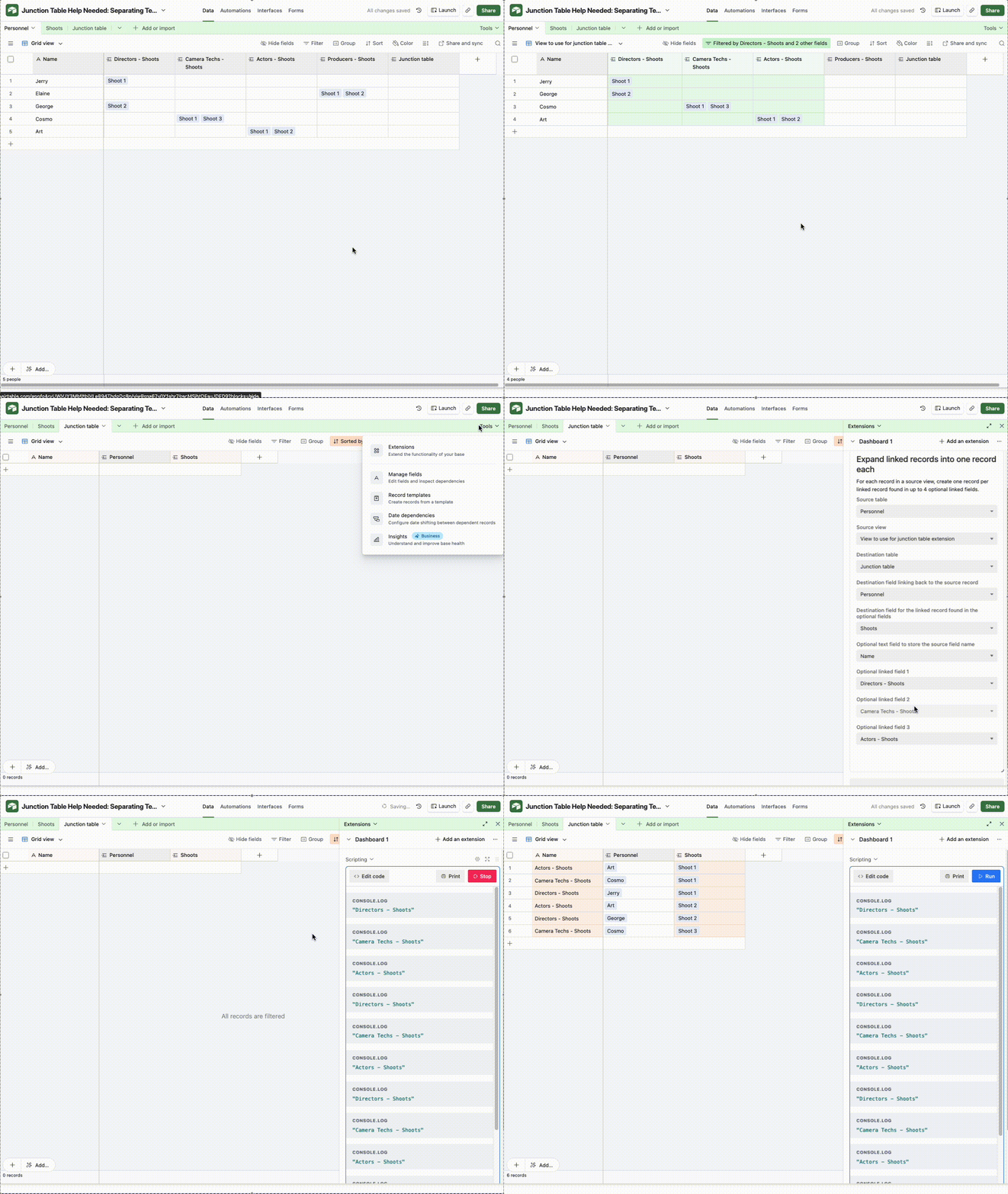
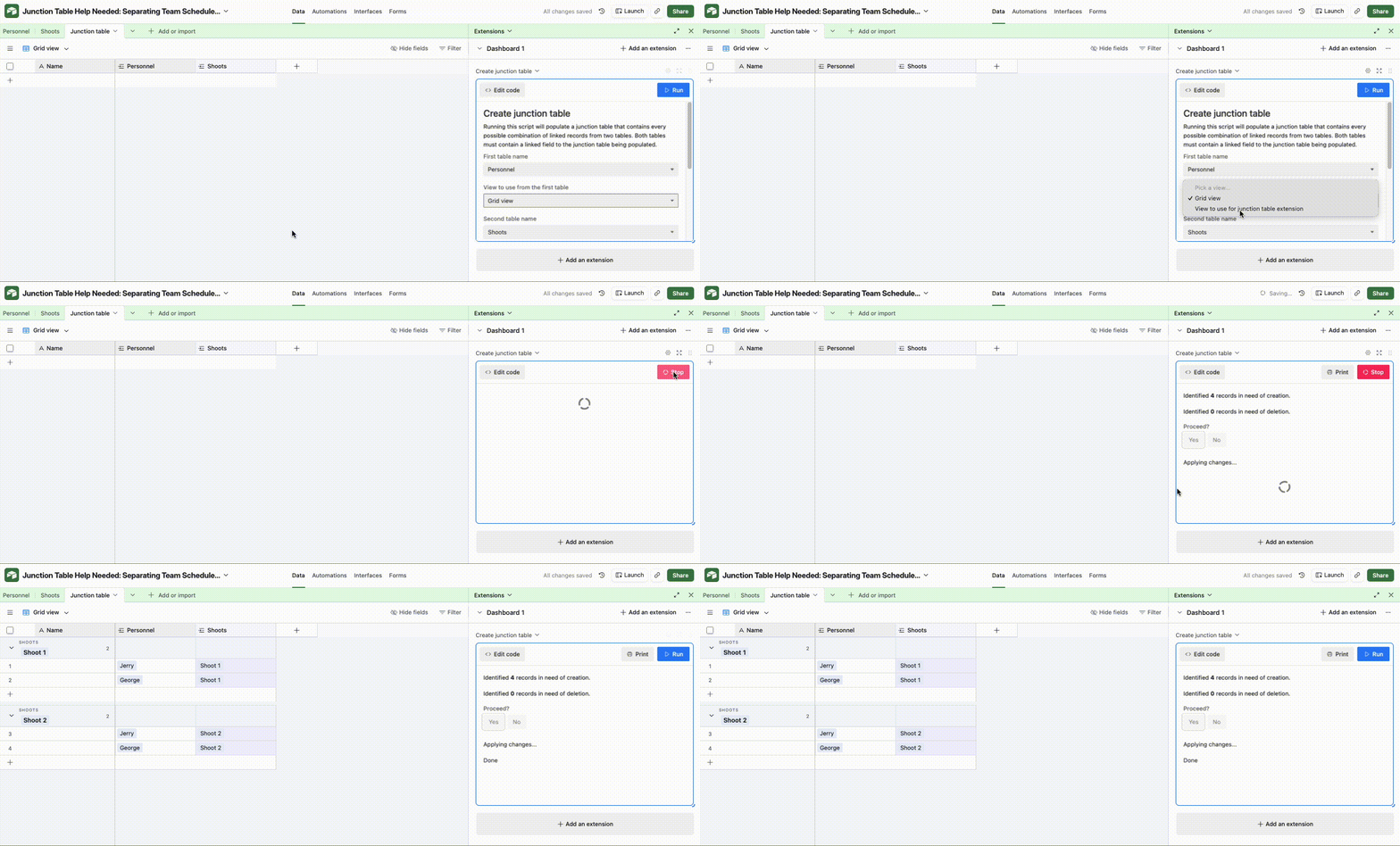
I’ve made the update to the script here for you to check out, and you can see how it works below
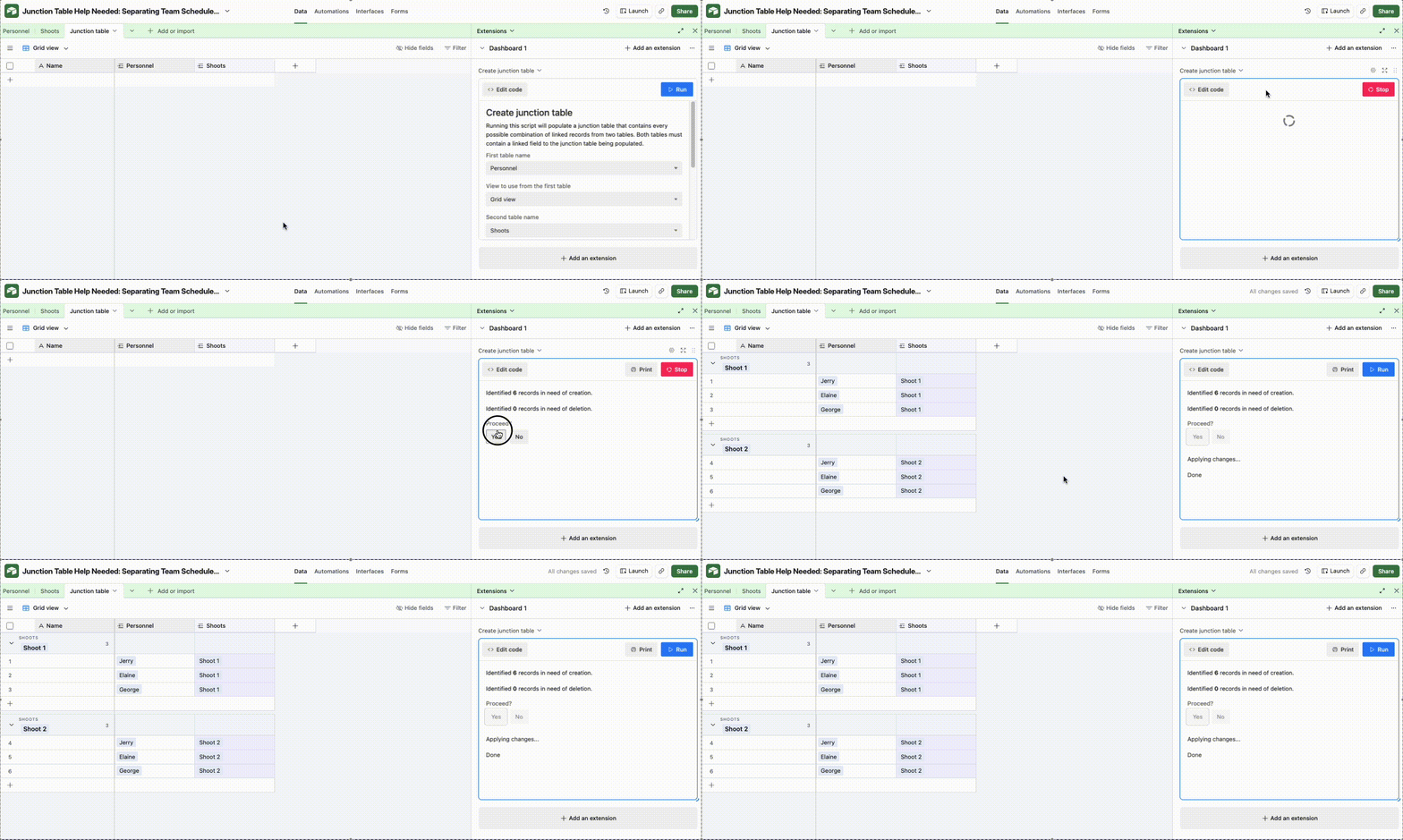
Here’s the original Personnel table and when we run the script on this view it creates one record per person per shoot:
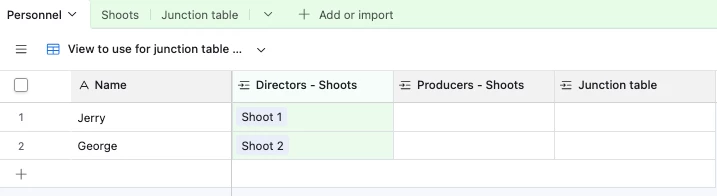
And here’s the view where we filtered to only show the records where the Directors field wasn’t empty:
And we select this view and run the script on that view instead:
Here’s the updated code!
let settings = input.config({ title: "Create junction table", description: `Running this script will populate a junction table that contains every possible combination of linked records from two tables. Both tables must contain a linked field to the junction table being populated.`, items: [ input.config.table("table1", { label: "First table name" }), input.config.view("view1", { parentTable:"table1", label: "View to use from the first table" }), input.config.table("table2", { label: "Second table name" }), input.config.table("junctionTable", { label: "Junction table name", }), input.config.field("firstJunctionField", { parentTable: "junctionTable", label: "First junction field name", description: "Linked record to first table", }), input.config.field("secondJunctionField", { parentTable: "junctionTable", label: "Second junction field name", description: "Linked record to second table", }), ], });
async function createJunction() { let { table1, view1, table2, junctionTable, firstJunctionField, secondJunctionField, } = settings;
if (table1 === junctionTable) { output.text("First table can't be the same as the junction table."); return; } if (table2 === junctionTable) { output.text("Second table can't be the same as the junction table."); return; } if (firstJunctionField === secondJunctionField) { output.text("First junction field can't be the same as the second junction field.") } if ( firstJunctionField.type !== "multipleRecordLinks" || secondJunctionField.type !== "multipleRecordLinks" ) { output.text( "First and second junction field should be of linked record type." ); return; }
let existing = Object.create(null); let toCreate = []; let toDelete = []; // Airtable limits batch operations to 50 records or fewer. let maxRecordsPerCall = 50;
// Part 1: determine the necessary operations. // // We don't modify the table contents in this Part in the interest of // efficiency. This script may trigger a large number of database // modifications, and it's much faster to request that they be done in batches. // When we identify a record that should be created or deleted, we add it to // the appropriate array so we can batch the operations in Part 2 of the // script.
let query3 = await junctionTable.selectRecordsAsync({ fields: [firstJunctionField, secondJunctionField], });
for (let record3 of query3.records) { let records1 = record3.getCellValue(firstJunctionField); let records2 = record3.getCellValue(secondJunctionField);
// Either field in the junction table may have zero records. That's not // expected, so junction records like that should be removed. if (!records1 || !records2) { toDelete.push(record3); continue; }
// Either field in the junction table may reference multiple records. // That's not expected, either, so junction records like that should be // removed. if (records1.length > 1 || records2.length > 1) { toDelete.push(record3); continue; }
let key = `${records1[0].id}${records2[0].id}`;
// Keep track of each record in the junction table that describes a unique // pair of foreign records. We'll use this to determine whether new records // need to be created. if (!(key in existing)) { existing[key] = record3;
// If we've already seen a record in the junction table for two foreign // records, then the current record is a duplicate, so we should plan // to remove it. } else { toDelete.push(record3); } }
let query1 = await view1.selectRecordsAsync(); let query2 = await table2.selectRecordsAsync();
for (let recordId1 of query1.recordIds) { for (let recordId2 of query2.recordIds) { let key = `${recordId1}${recordId2}`;
// If we didn't see this combination of foreign records when we // traversed the junction table, we should plan to create a new record. if (!(key in existing)) { toCreate.push({ fields: { [firstJunctionField.name]: [{ id: recordId1 }], [secondJunctionField.name]: [{ id: recordId2 }], }, });
// If we *did* see this combination of foreign records, then we'll // remove the corresponding junction record from our data // structure. That way, once this loop is complete, the only // records that remain in the data structure will be the ones that // describe non-existent foreign records. } else { delete existing[key]; } } }
// If `existing` still has any entries, they are junction records which include // non-existent foreign records. We should delete those, too. toDelete.push(...Object.values(existing));
// Part 2: Verify // // Inform the script's user of the changes to be made and await their // confirmation. output.markdown( `Identified **${toCreate.length}** records in need of creation.` ); output.markdown( `Identified **${toDelete.length}** records in need of deletion.` );
let decision = await input.buttonsAsync("Proceed?", ["Yes", "No"]);
Instead of using the extension to generate the junction table, use a script to do so. In your script you can use whatever logic makes sense, such as excluding certain roles, etc.
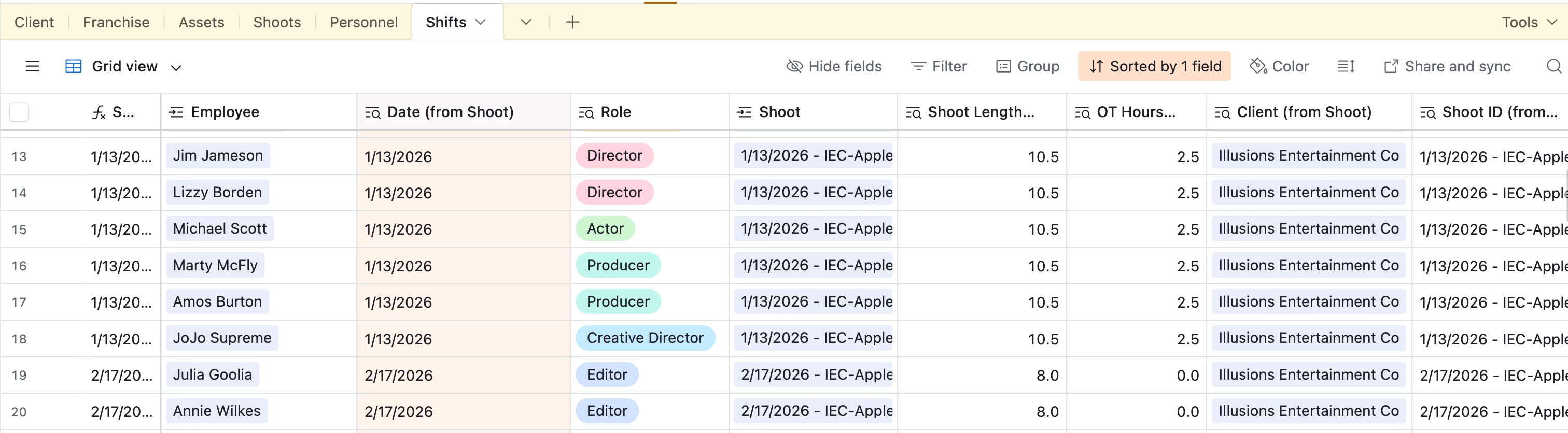
@TheTimeSavingCo Thank so much you for putting that together! I applied the script to my test base and while it does filter out positions that are not referenced in the Shoots table by using a view in the Personnel table, it is creating Shift records with personnel that were not assigned to that Shoot:
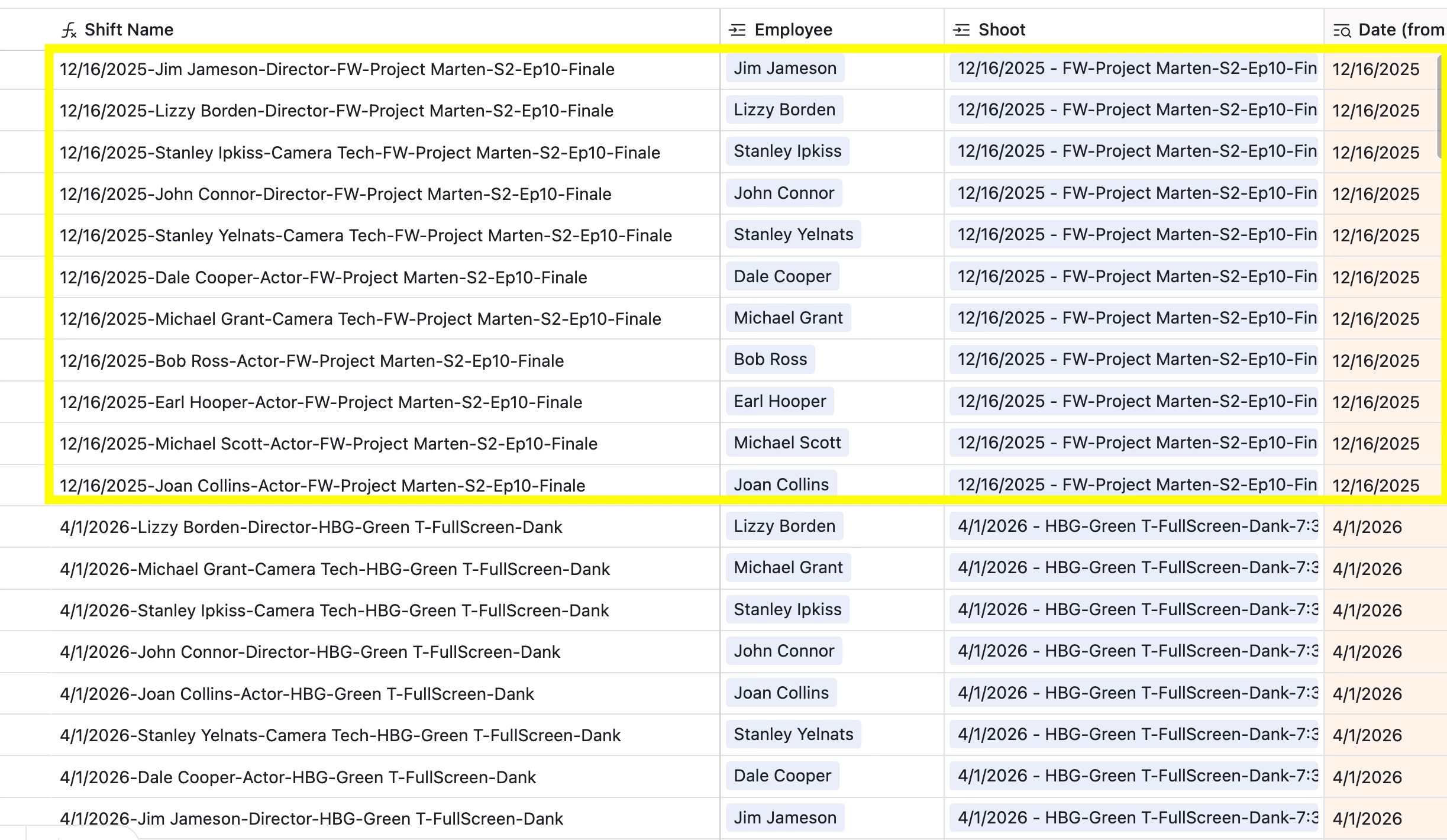
For example, wee the first shoot listed for 12/16/25 for Proj. Marten in the Shoots table: The only personnel attached to that shoot is J Connor, M Grant, D Cooper, and Joan Collins
In the Shifts table (junction), it has created entries for additional personnel never assigned to that shoot:
@VikasVimal If I knew how to script and set custom parameters within that script, I would! Unfortunately, I do not have the skill set to build it out myself. 🙂
Ah you’re right, so sorry! I’ve updated the base with a new script that I think should do what you need, let me know if it’s wrong and I’ll fix it up!
The new script will ask for:
A view in Personnel for you to select from
For each of those records in Personnel, the specific linked fields that you want to create records for
And so with reference to the screenshot below, it’ll create 2 records for Cosmo, one for Shoot 1 and one for Shoot 2
This can also be set up to be an automation, but that really depends on the workflow. Thinking about this, it feels like you’d probably be setting up all the Personnel data on a per Shoot basis, and then creating all the Shifts at once from there?
Code:
let config = input.config({ title: "Expand linked records into one record each", description: "For each record in a source view, create one record per linked record found in up to 4 optional linked fields.", items: [ input.config.table("sourceTable", { label: "Source table" }), input.config.view("sourceView", { parentTable: "sourceTable", label: "Source view" }), input.config.table("destinationTable", { label: "Destination table" }), input.config.field("destinationSourceField", { parentTable: "destinationTable", label: "Destination field linking back to the source record" }), input.config.field("destinationLinkedField", { parentTable: "destinationTable", label: "Destination field for the linked record found in the optional fields" }), input.config.field("destinationFieldNameField", { parentTable: "destinationTable", label: "Optional text field to store the source field name" }), input.config.field("optionalLinkedField1", { parentTable: "sourceTable", label: "Optional linked field 1" }), input.config.field("optionalLinkedField2", { parentTable: "sourceTable", label: "Optional linked field 2" }), input.config.field("optionalLinkedField3", { parentTable: "sourceTable", label: "Optional linked field 3" }) ] });
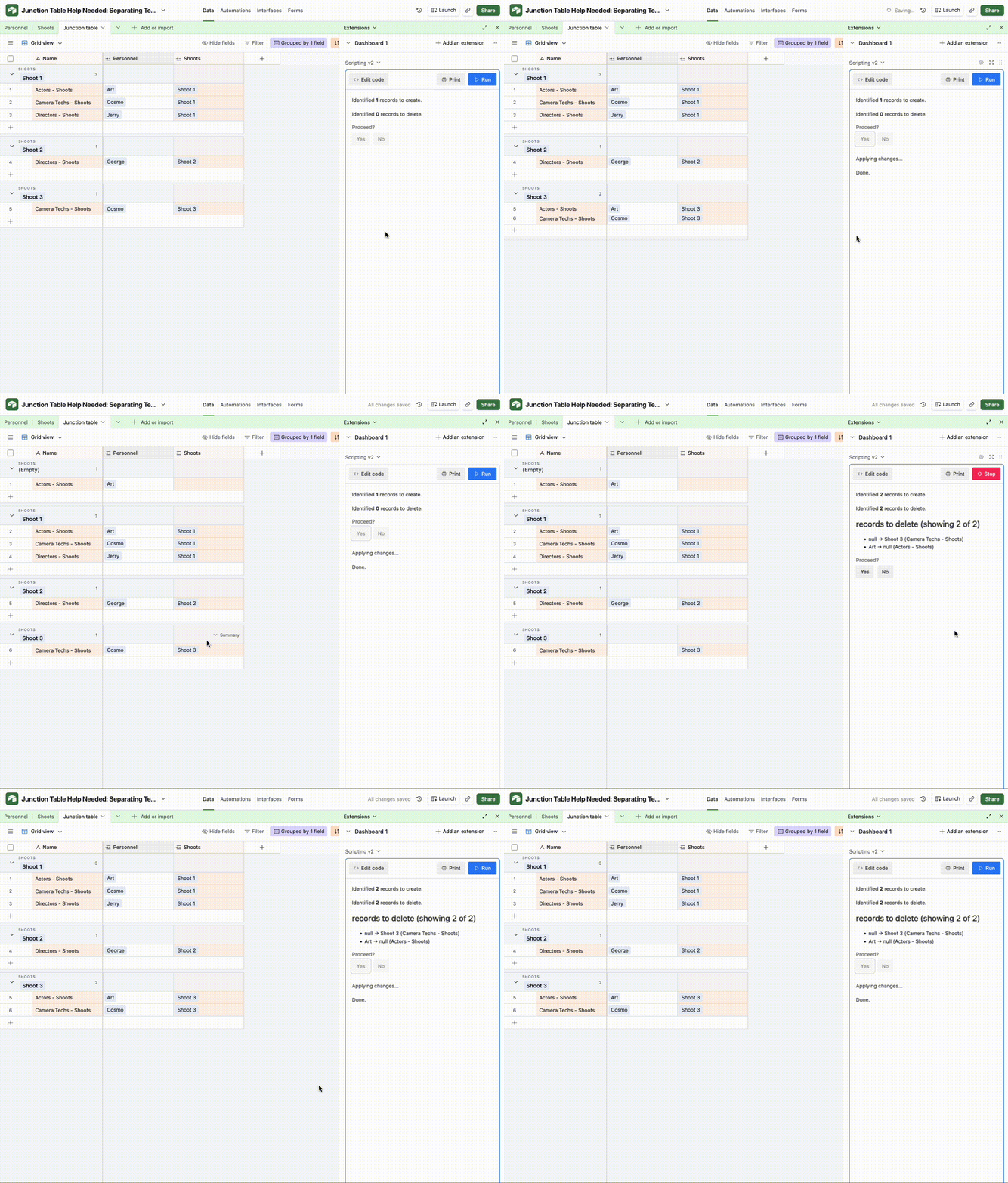
@TheTimeSavingCo This is fantastic, I cannot thank you enough! Last question: In the original script, before creating new records it would run a query and would determine which records to ignore as duplicates, how many need to be created, and how many will be deleted prior to completing the run.
This was the original section of the script addressing this:
// Part 1: determine the necessary operations. // // We don't modify the table contents in this Part in the interest of // efficiency. This script may trigger a large number of database // modifications, and it's much faster to request that they be done in batches. // When we identify a record that should be created or deleted, we add it to // the appropriate array so we can batch the operations in Part 2 of the // script.
let query3 = await junctionTable.selectRecordsAsync({ fields: [firstJunctionField, secondJunctionField], });
for (let record3 of query3.records) { let records1 = record3.getCellValue(firstJunctionField); let records2 = record3.getCellValue(secondJunctionField);
// Either field in the junction table may have zero records. That's not // expected, so junction records like that should be removed. if (!records1 || !records2) { toDelete.push(record3); continue; }
// Either field in the junction table may reference multiple records. // That's not expected, either, so junction records like that should be // removed. if (records1.length > 1 || records2.length > 1) { toDelete.push(record3); continue; }
let key = `${records1[0].id}${records2[0].id}`;
// Keep track of each record in the junction table that describes a unique // pair of foreign records. We'll use this to determine whether new records // need to be created. if (!(key in existing)) { existing[key] = record3;
// If we've already seen a record in the junction table for two foreign // records, then the current record is a duplicate, so we should plan // to remove it. } else { toDelete.push(record3); } }
let query1 = await view1.selectRecordsAsync(); let query2 = await table2.selectRecordsAsync();
for (let recordId1 of query1.recordIds) { for (let recordId2 of query2.recordIds) { let key = `${recordId1}${recordId2}`;
// If we didn't see this combination of foreign records when we // traversed the junction table, we should plan to create a new record. if (!(key in existing)) { toCreate.push({ fields: { [firstJunctionField.name]: [{ id: recordId1 }], [secondJunctionField.name]: [{ id: recordId2 }], }, });
// If we *did* see this combination of foreign records, then we'll // remove the corresponding junction record from our data // structure. That way, once this loop is complete, the only // records that remain in the data structure will be the ones that // describe non-existent foreign records. } else { delete existing[key]; } } }
// If `existing` still has any entries, they are junction records which include // non-existent foreign records. We should delete those, too. toDelete.push(...Object.values(existing));
// Part 2: Verify // // Inform the script's user of the changes to be made and await their // confirmation. output.markdown( `Identified **${toCreate.length}** records in need of creation.` ); output.markdown( `Identified **${toDelete.length}** records in need of deletion.` );
let decision = await input.buttonsAsync("Proceed?", ["Yes", "No"]);
@VikasVimal If I knew how to script and set custom parameters within that script, I would! Unfortunately, I do not have the skill set to build it out myself. 🙂
Here, build this to help: https://chatgpt.com/g/g-GuMycukiN-vik-s-scripting-helper you can always duplicate the base and try building a script. You don’t need to know code, but you need to provide enough context for the AI to understand what fields you’re talking about and what logic you need to build. Start with something simple, like pick the latest 10 records and show in output and take it from there.
let config = input.config({ title: "Expand linked records into one record each", description: "For each record in a source view, create one record per linked record found in up to 3 optional linked fields, while also removing invalid, duplicate, and obsolete junction records.", items: [ input.config.table("sourceTable", { label: "Source table" }), input.config.view("sourceView", { parentTable: "sourceTable", label: "Source view" }), input.config.table("destinationTable", { label: "Destination table" }), input.config.field("destinationSourceField", { parentTable: "destinationTable", label: "Destination field linking back to the source record" }), input.config.field("destinationLinkedField", { parentTable: "destinationTable", label: "Destination field for the linked record found in the optional fields" }), input.config.field("destinationFieldNameField", { parentTable: "destinationTable", label: "Optional text field to store the source field name" }), input.config.field("optionalLinkedField1", { parentTable: "sourceTable", label: "Optional linked field 1" }), input.config.field("optionalLinkedField2", { parentTable: "sourceTable", label: "Optional linked field 2" }), input.config.field("optionalLinkedField3", { parentTable: "sourceTable", label: "Optional linked field 3" }) ] });
let linkedFields = [ optionalLinkedField1, optionalLinkedField2, optionalLinkedField3 ].filter(Boolean);
if (linkedFields.length === 0) { throw new Error("You need to select at least one linked field."); }
let maxRecordsPerCall = 50;
// This will track all source/linked combinations that SHOULD exist. let desiredPairs = {}; let toCreate = []; let toDelete = []; let existing = {};
// Pull source records from the selected view. let sourceQuery = await sourceView.selectRecordsAsync({ fields: linkedFields });
// Part 1A: Determine all desired source/linked pairs from the source view. for (let sourceRecord of sourceQuery.records) { for (let linkedField of linkedFields) { let linkedRecords = sourceRecord.getCellValue(linkedField);
if (!linkedRecords || linkedRecords.length === 0) { continue; }
for (let linkedRecord of linkedRecords) { let key = `${sourceRecord.id}___${linkedRecord.id}`;
// If the same pair appears in multiple linked fields, keep the first one. if (!(key in desiredPairs)) { let fields = { [destinationSourceField.id]: [{ id: sourceRecord.id }], [destinationLinkedField.id]: [{ id: linkedRecord.id }] };
if (destinationFieldNameField) { fields[destinationFieldNameField.id] = linkedField.name; }
desiredPairs[key] = { fields }; } } } }
// Pull existing junction records from the destination table. let destinationFields = [destinationSourceField, destinationLinkedField]; if (destinationFieldNameField) { destinationFields.push(destinationFieldNameField); }
let junctionQuery = await destinationTable.selectRecordsAsync({ fields: destinationFields });
// Part 1B: Inspect existing junction records and identify invalid/duplicate ones. for (let junctionRecord of junctionQuery.records) { let sourceLinks = junctionRecord.getCellValue(destinationSourceField); let linkedLinks = junctionRecord.getCellValue(destinationLinkedField);
// Multiple links in either junction field: invalid if (sourceLinks.length > 1 || linkedLinks.length > 1) { toDelete.push(junctionRecord); continue; }
let key = `${sourceLinks[0].id}___${linkedLinks[0].id}`;
// Keep first valid record for each pair, delete duplicates if (!(key in existing)) { existing[key] = junctionRecord; } else { toDelete.push(junctionRecord); } }
// Part 1C: Compare desired pairs to existing pairs. for (let key of Object.keys(desiredPairs)) { if (!(key in existing)) { toCreate.push(desiredPairs[key]); } else { // Pair already exists, so remove from existing. // Any leftovers in existing after this are obsolete and should be deleted. delete existing[key]; } }
// Any remaining existing records represent obsolete pairs. toDelete.push(...Object.values(existing));
// Part 2: Verify output.markdown(`Identified **${toCreate.length}** records to create.`); output.markdown(`Identified **${toDelete.length}** records to delete.`);
let previewLimit = 20;
if (toDelete.length > 0) { let preview = toDelete.slice(0, previewLimit).map(record => { let sourceLinks = record.getCellValue(destinationSourceField); let linkedLinks = record.getCellValue(destinationLinkedField);
let source = sourceLinks?.[0]; let linked = linkedLinks?.[0];
let sourceDisplay = source?.name || source?.id || "null"; let linkedDisplay = linked?.name || linked?.id || "null";
let fieldName = destinationFieldNameField ? record.getCellValue(destinationFieldNameField) || "" : "";
output.markdown(`### records to delete (showing ${Math.min(previewLimit, toDelete.length)} of ${toDelete.length})`); output.markdown(preview.join("\n")); } else { }
let decision = await input.buttonsAsync("Proceed?", ["Yes", "No"]);
// Part 3: Execute if (decision === "No") { output.text("Operation cancelled."); } else { output.text("Applying changes...");