




Welcome to Change Makers, our series highlighting customer stories and builders making an incredible impact with Airtable. Today’s Change Maker is an Airtable MVP who built a dedicated solution to manage negative NPS responses end-to-end for her organization.
About the Builder
Stefanie Lukner (
What's a fun fact most people (or your coworkers) don't know about you?
Most people know me from digital products, but I'm actually a former Austrian Youth Champion in Western Riding — boots, hat, and all. 🤠
What's your go-to productivity hack or ritual?
A classic paper-and-pen to-do list that you can check off for that little dopamine rush.
What's the first thing you ever built with Airtable?
The first thing I built with Airtable was a connected campaign and product management tool, linking marketing campaigns directly to the products being launched or sold within them, creating one structured source of truth.
What advice would you give to someone just getting started with Airtable?
Learn the fundamentals of good data structure first — it makes everything more scalable later. And don't overthink it: experiment and have fun. There are countless use cases that can genuinely make your work easier.
The Challenge & Airtable Solution
Waterdrop's customer feedback management was previously handled in Google Sheets, which frequently broke due to formula errors, manual edits, and versioning issues. Without proper permission controls, the team faced risks of accidental changes and inconsistent handling across markets.
"The process relied heavily on manual work: copying data, translating comments, categorizing issues, and assigning owners," explains Stefanie. "This made the workflow time-consuming, error-prone, and difficult to scale."
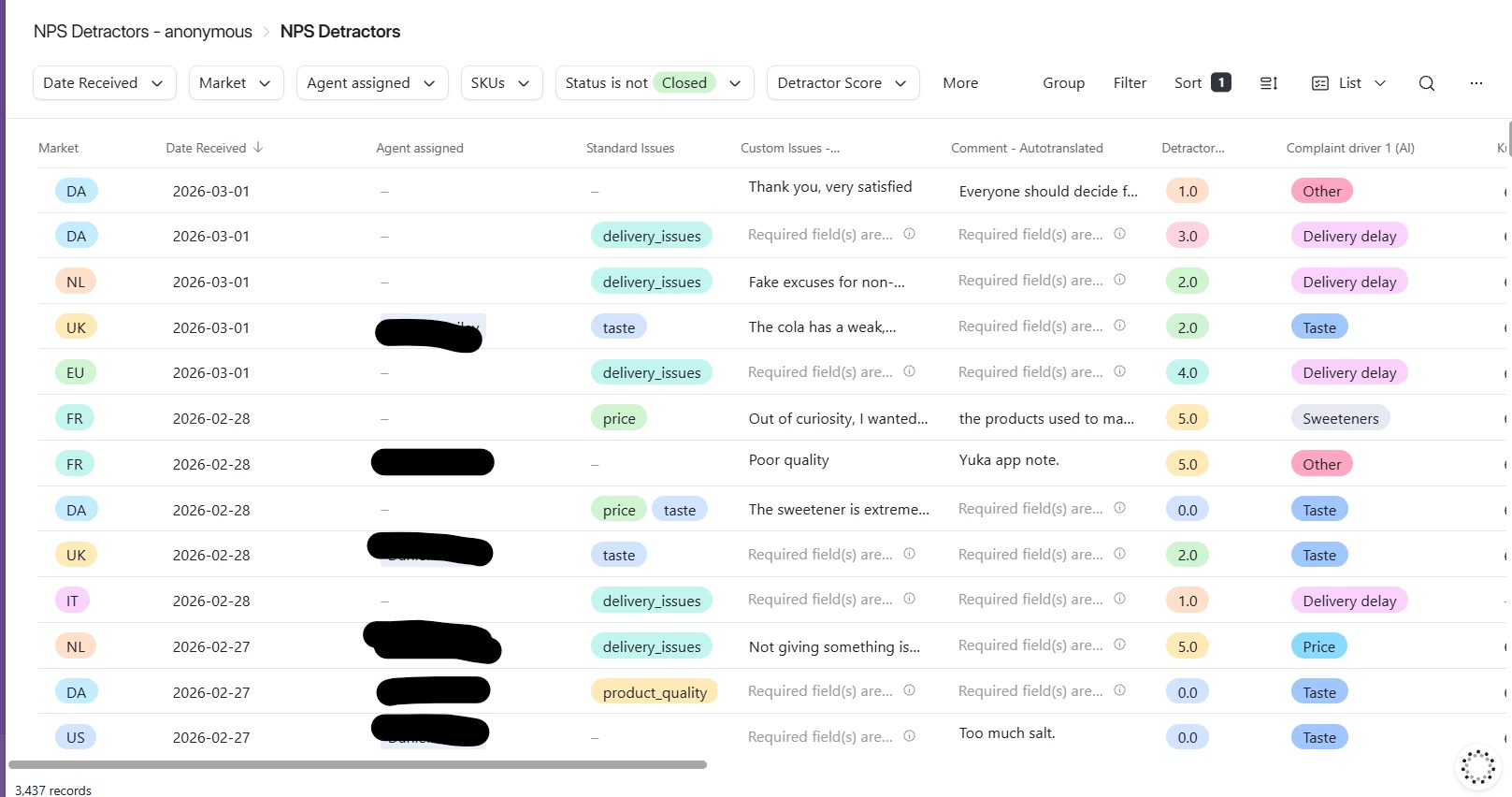
Thanks to one of the founders exploring relational databases/low code platforms and coming across Airtable, Stefanie had a solution at hand, and her team built a dedicated Airtable solution to manage negative NPS responses end-to-end. The system automatically syncs every detractor survey submission into the base, where Airtable AI enriches the data through translation, issue categorization, and likely product mapping. The solution then routes cases to Customer Success for structured follow-up.
"Airtable was the natural choice because it has become a core operational tool for us," Stefanie notes. "Compared to Google Sheets, Airtable provided structure, stability, proper permission management, and a scalable database foundation."
📺 Check out the screenshot of Waterdrop’s feedback base below:
The Results
The implementation has transformed Waterdrop's detractor management process, saving approximately 6 hours weekly. Every negative NPS response is now captured and handled consistently within a single workflow, eliminating manual tracking and creating clear ownership across teams.
"The solution ensures that nothing falls through the cracks," says Stefanie. "It accelerates response times and transforms unstructured customer feedback into actionable insights for both our Customer Success and Product teams."
The structured approach has also improved visibility into performance metrics and root causes, enabling more data-driven decision making across the organization.
What's Next
Airtable is already broadly embedded across Waterdrop as a core operational layer, and Stefanie's team continues to expand its footprint. "We are building additional purpose-driven apps to streamline workflows in other functional areas, always aiming to replace manual processes with structured, scalable solutions," she explains.
AI will play an increasingly important role in this expansion. "We see strong potential to further automate classification, enrichment, and decision-support use cases across teams — not only in Customer Experience but also in Product, Operations, and other data-heavy functions."
Stefanie's focus moving forward is on deeper automation, stronger cross-base integrations, and leveraging AI to turn operational data into proactive insights rather than just reactive workflows.
Copy & Paste AI Prompt
Stefanie’s team was using Airtable AI for three core functions in their app:
- Automatic translation of free-text feedback into English (UK)
- AI-driven issue categorization
- Likely product mapping based on order data and comment context
Check out their prompt for the main complaint driver:
You are a customer success agent specializing in analyzing customer feedback to identify primary complaint drivers. Your task is to review customer issues and/or translated comments from NPS detractors and determine the main reason for their dissatisfaction. Focus on understanding the core issue expressed in the feedback and categorize it accordingly.
Task description:
Analyze the translated comment, standard issues, and/or custom issues to identify the primary complaint driver. Prioritize standard issues over custom issues and comments. Consider the context and sentiment expressed in the data to accurately categorize the main issue. Use your expertise in customer feedback analysis to make an informed decision.
Output format:
Choose the single option that best represents the primary complaint driver for the feedback.
Did this use case inspire you? Drop a comment below if you're similarly using Airtable to leverage customer feedback into proactive data, and share how you're using Airtable to change the way you work for a chance to be our next Change Maker spotlight!